







CROYDON COMMON FOOTBALL CLUB





IN MEMORIAM
More than 200 players appeared for the Croydon Common first team during its professional life (1907-1916) and it is reasonable to assume that several of these must have been killed during the Great War. However, many players only played a small number of games for the club and so it is almost impossible to gather information on them - particularly if they did not also play for other professional clubs - and to discover whether they lost their lives during the war. Of the 120 or so players recorded in the Biographies page of this website, at least seven who had appeared for the club's first team lost their lives in the Great War. This page is dedicated to them and to any other Robins who also died serving their country.
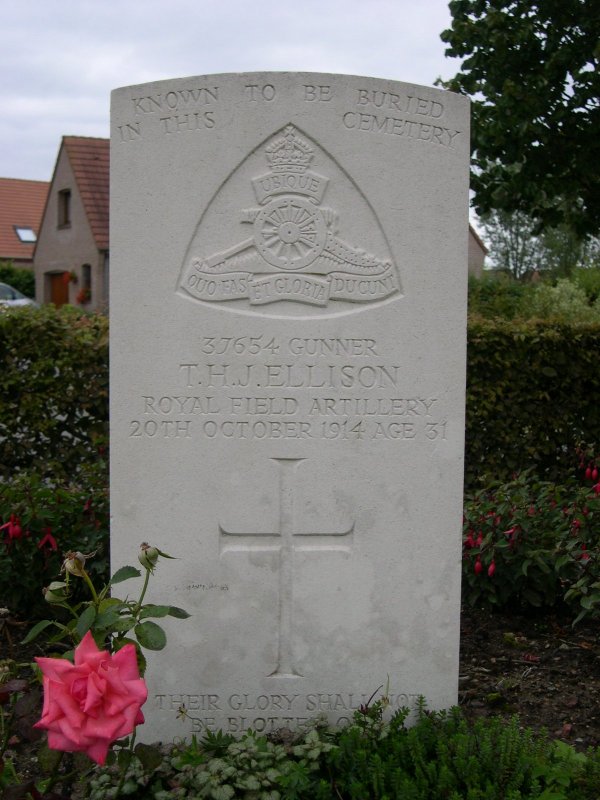
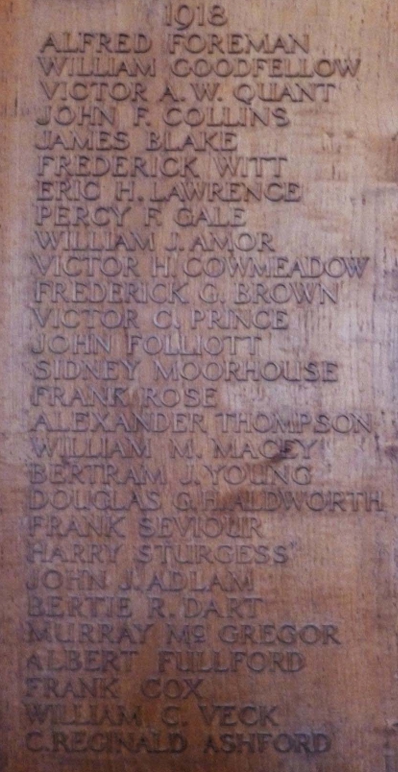
Click on the thumbnails to see photographs of the gravestones/memorials and the Commonwealth War Graves Commission certificates.
 |
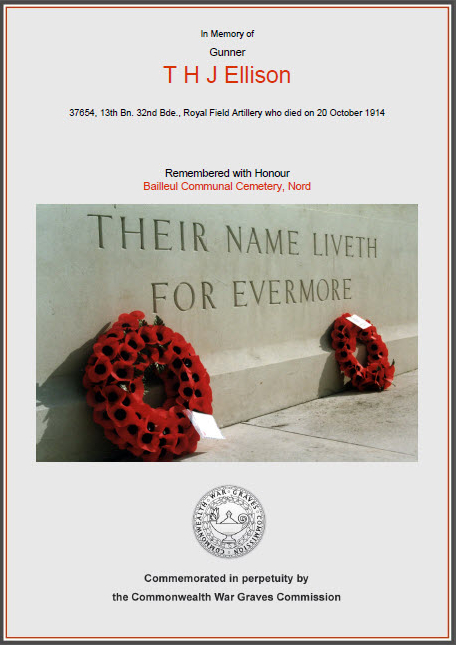 |
THOMAS ELLISON played for the club during the 1912-1913 and 1913-1914 seasons as a forward, scoring twice in six appearances. He joined up at the outbreak of war, becoming Gunner 37654 in the 13th Battalion of the 32nd Brigade of the Royal Field Artillery. He was killed on 20 October 1914 and is buried in the Bailleul Communal Cemetery in France. Unfortunately, his was one of several graves destroyed when a shell hit the cemetery in 1918, with the result that his headstone merely records that he is "known to be buried in this cemetery". He also played for Colchester Town and Grays Athletic, but it appears that Croydon Common was his only senior club. On Saturday 11 October 2014, before an F.A. Cup 3rd Qualifying Round match with Bromley, the players, supporters and officials of Grays Athletic F.C. marked the 100th anniversary of his death by holding a minute's silence, while the club captain laid a wreath on the pitch and a bugler sounded the last post. |
 |
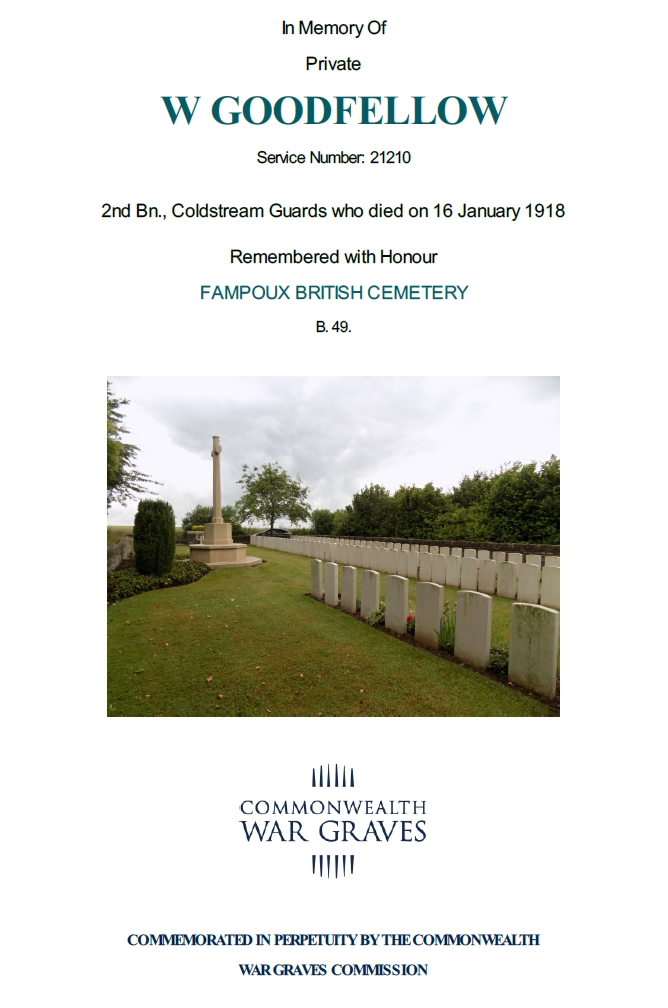 |
WILLIAM GOODFELLOW was born in Alderbury in around 1885, he played several seasons for a number of local clubs before he joined Croydon Common in 1912; Fisherton Rangers, Sarum Swifts, Salisbury City, Salisbury Rangers, Harnham, Salisbury Amateurs and Salisbury City (again). In between his spells at the last two of these, he was on the books of Queens Park Rangers, but he made no first team appearances. During the time that he played for local amateur clubs in the Salisbury area, he worked as a mason’s labourer and a life assurance agent. He made just 8 appearances for the Robins in the Southern League and Southern Football Alliance, without scoring, during the 1912-13 campaign, before returning to Salisbury City the following season. He was also a successful local cricketer in the Salisbury & District League. After three years as a territorial, in 1917 he joined the 2nd. Battalion, Coldstream Guards as Private 21210 and was killed on 16 January 1918 and is buried in the Fampoux British Cemetery in France. His name is on the memorial board at St. Martin's Church in Milford that appears on the left. He is also mentioned on the memorial board at All Saints Church in East Harnham. |
 |
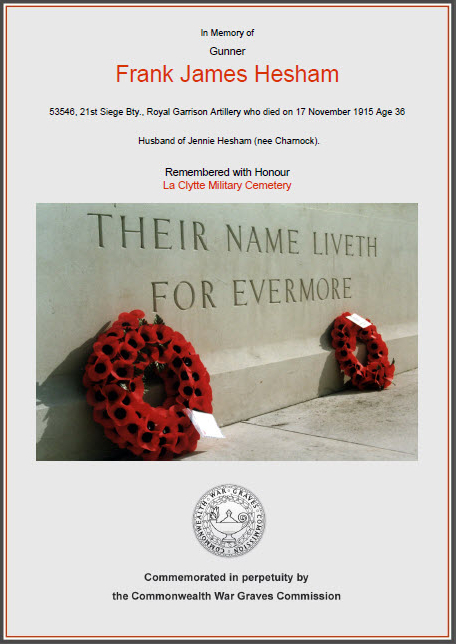 |
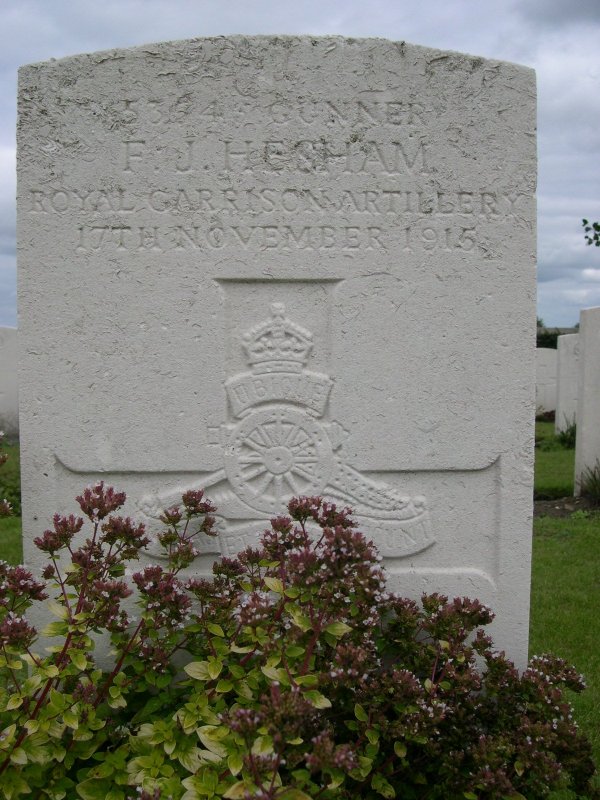
FRANK HESHAM was born in Chorlton, Lancashire in 1878
and played for local junior club Gorton St. Francis before signing on
with Manchester City for the 1897-98 campaign. However, in his two
seasons at the club, he only made 3 Football League appearances, without
scoring.
After short spells
at both Crewe Alexandra and Accrington Stanley, he joined Stoke where he
played 17 Football League matches during the 1904-05 season, scoring
once. Then, he had spells with
Leyton (33 games, 5 goals), Oldham Athletic (40 games, 10 goals) and
Preston North End, where he made no first team appearances.
He joined Croydon Common just
after the beginning of the 1909-10 season, the club’s first in Division
One of the Southern League, and he was the club's top scorer that season
with 17 goals from 32 matches.
His good form continued the following season and he scored 13
goals in 24 games.
At the end of
the campaign, he moved back to the Manchester area and joined Hyde and
then Newton Heath Albion two seasons later.
During the war, he firstly served with the 4th. Volunteer
Battalion, Manchester Regiment and was awarded the 1914-1915 Star.
However, he was killed in action
on 17 November 1915 while serving with the 21st. Siege Battery, Royal
Garrison Artillery.
He is buried
in La Clytte Military Cemetery in Heuvelland, Belgium.
One newspaper reported his death
with the comment that “The news of his
gallant sacrifice will be received with mingled feelings of pride and
regret”. |
 |
ROBERT HEWITSON
was
born in Alnwick in 1880. His first club was Morpeth Harriers and, while
he was there in 1902-03, the club won the Northumberland Senior Cup and
the Northern Alliance championship.
He signed with Barnsley in May 1903 and made 62 Football League
and F.A. Cup appearances for the Yorkshire club in his two seasons
there, before coming south to sign with Crystal Palace. In his first
season, 1905-06, Crystal Palace won the championship of Division Two of
the Southern League. He
spent two seasons at the club and played in 75 Southern League and F.A.
Cup matches before joining Oldham Athletic.
At the start of the 1907-08 season, he appeared for Oldham
Athletic in the club’s first ever Football League match and played 31
league and F.A. Cup matches that season, but he missed some following
suspension for allegedly throwing mud at a referee. After one season, he
returned to London to join Tottenham Hotspur and once again played in a
club’s first ever Football League match when he played for them at the
start of the 1908-09 season; a campaign which saw the Spurs win
promotion to Division One at its first attempt. However, after 34
Football League and F.A. Cup appearances, he did not stay for the club’s
first season in the top flight and instead moved to Croydon Common to be
part of the squad being put together for the Robins’ first campaign in
Division One of the Southern League. He played 40 games in his single
season at The Nest, 1909-10, before moving on to Doncaster Rovers.
Thereafter, he appeared for
local junior clubs Pogmoor (based in Barnsley) and Cambois (based in
Blyth). He joined the Black
Watch (Royal Highlanders) as Private S/43291 and was killed in action
during the Battle of the Somme on 18 September 1916.
He is buried in the Contalmaison Chateau Cemetery in France.
He is remembered on a memorial in St Mary's Church, Blyth and on
one in Beaconsfield Street in the same town.
His brother Henry had died five months earlier while serving with
the Northumberland Fusiliers. |
|
 |
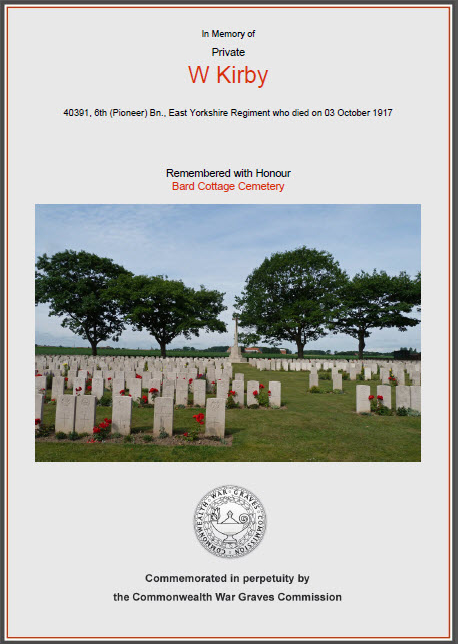 |
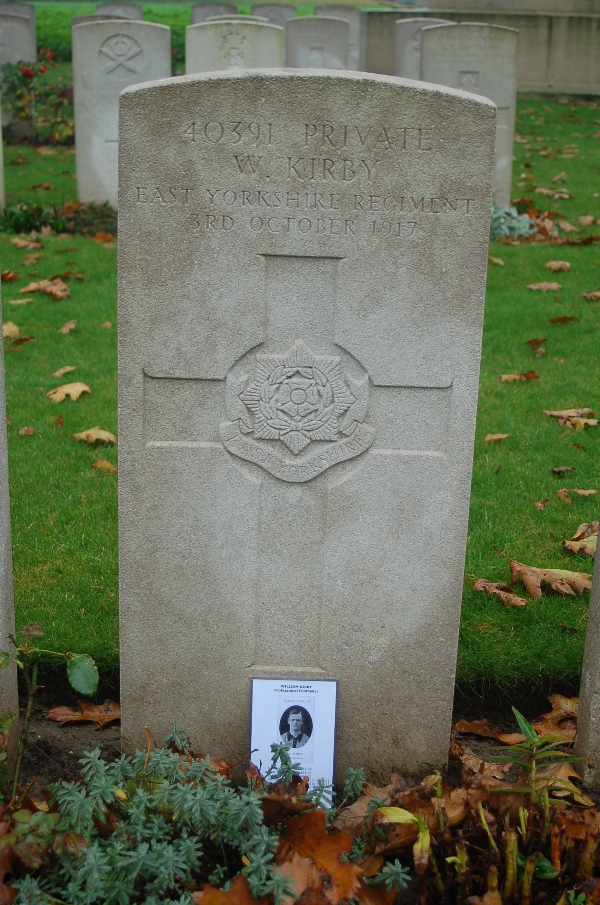
WILLIAM KIRBY
was
born
in Preston in 1882 and was known throughout his playing career as “Sunny
Jim”. He played for local
junior club Emmanuel Rovers before signing on with Preston North End in
1900, but he made no first team appearances before joining
Oswaldtwistle Rovers.
In 1902, he came south and played for Swindon Town (33 games, 11 goals)
in 1902-03, West Ham United (36 games, 11 goals) in 1903-04 and Swindon
Town once more (21 games, 4 goals) in 1904-05.
Thereafter, he spent seven seasons with Portsmouth, where he scored
107 goals in 277 Southern League, Western League and F.A. Cup matches;
an impressive strike rate. He
was the club’s top scorer during the 1906-07 season
when the club came second in Division One of the Southern League.
In October 1910, Portsmouth awarded him a benefit match to
acknowledge his one hundredth goal for the club and he received the sum
of £220.
Strangely, while he was playing for several Southern League clubs
between 1901 and 1911, his registration was still retained by Preston
North End; this is because it was a Football League club and there was
no reciprocal arrangement between that league and the Southern League
regarding contracts. However, he
returned to Preston North End for the 1911-12 season and finally played
in the Football League after ten campaigns in the Southern League. He
scored 14 goals in 39 Football League and F.A. Cup matches to make him
the club’s top scorer that season.
The following season he scored 8 times in 17 Football League
matches as the club won the championship of Division Two.
However, at the start of the
1913-14 campaign, he moved to Exeter City, where he played 5 Southern
League matches without scoring before completing the season with Merthyr
Town, playing 29 Southern League games and scoring 6 goals.
While at
Merthyr Town during the 1913-14 season, he played in several matches
with Alexander Weir; they would later play together for the Robins
during the 1915-16 season.
At the end of the 1913-14 season, Merthyr Town was relegated from
Division One of the Southern League.
His war service reduced his opportunities to play for the club
during the following season, but he fractured two ribs playing against
Swansea Town on Christmas Day 1914.
He joined
Croydon Common halfway through the 1915-1916 season, when the club was
competing in the London Combination following the discontinuation of the
Southern League after the outbreak of war.
He scored 6 goals in his 16 games for the Robins and played in
the club’s last ever game. The following season, after the club had
folded, he appeared for Brentford in the same competition (18 games, 2
goals). When the war
started, he originally joined the Royal Engineers, but he was invalided
out and so worked at the Woolwich Arsenal; however, he apparently did
not enjoy the conditions there and so he instead enlisted with the East
Yorkshire Regiment.
However, shortly afterwards, he was killed at Ypres on 3 October 1917
and he is buried in the Bard Cottage Cemetery near Ypres, Belgium.
Sadly, he left a wife and five children. |
 |
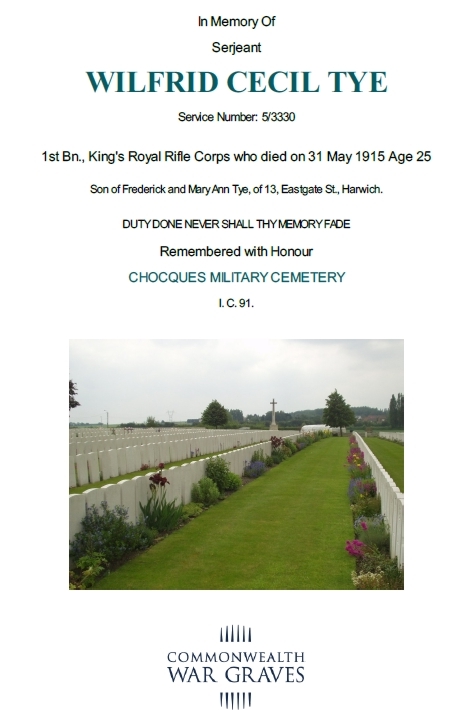 |
WILFRED TYE was born in Harwich in 1890 and played for his home town club, Harwich & Parkeston, during the 1909-10 season. In 1910, he joined the 5th. Battalion of the King's Royal Rifle Corps, with the service number 522419, but he may have left shortly afterwards as the 1911 census records him as a general labourer. By November that year he had signed with Croydon Common and he made three first team appearances that season, scoring three goals. He made four appearances the following season and again scored three times. Given his scoring record of nearly a goal a game, one wonders why he did not make more appearances for the club. Either way, he was back playing for Harwich & Parkeston the following season. When war came, he went to France with the King's Royal Rifle Corps and served as Serjeant 5/3330 in the 1st. Battalion. He was killed on 31 May 1915 and is buried in the Chocques Military Cemetery. His family arranged for his headstone to carry the additional inscription "Duty done never shall thy memory fade". Sadly his elder brother John Frederick Tye was killed on 2 November 1917 while serving as Serjeant 340074 in the 88th. Siege Battery of the Royal Garrison Artillery and is buried in the Cement House Cemetery in Belgium. Both are remembered on the memorial in the church in which they were baptised; St. Nicholas, Harwich. A photograph of the memorial appears on the left. |
 |
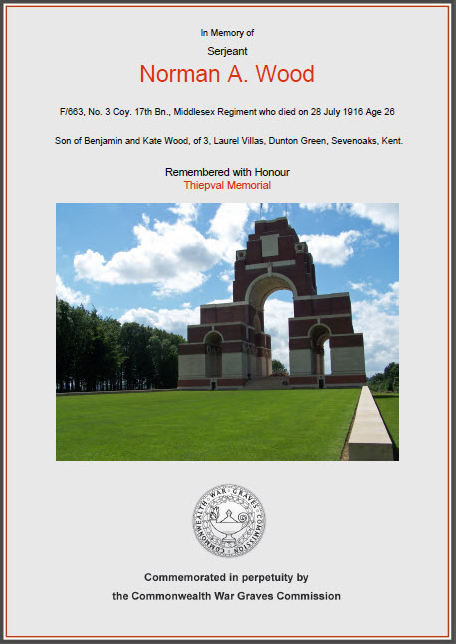 |
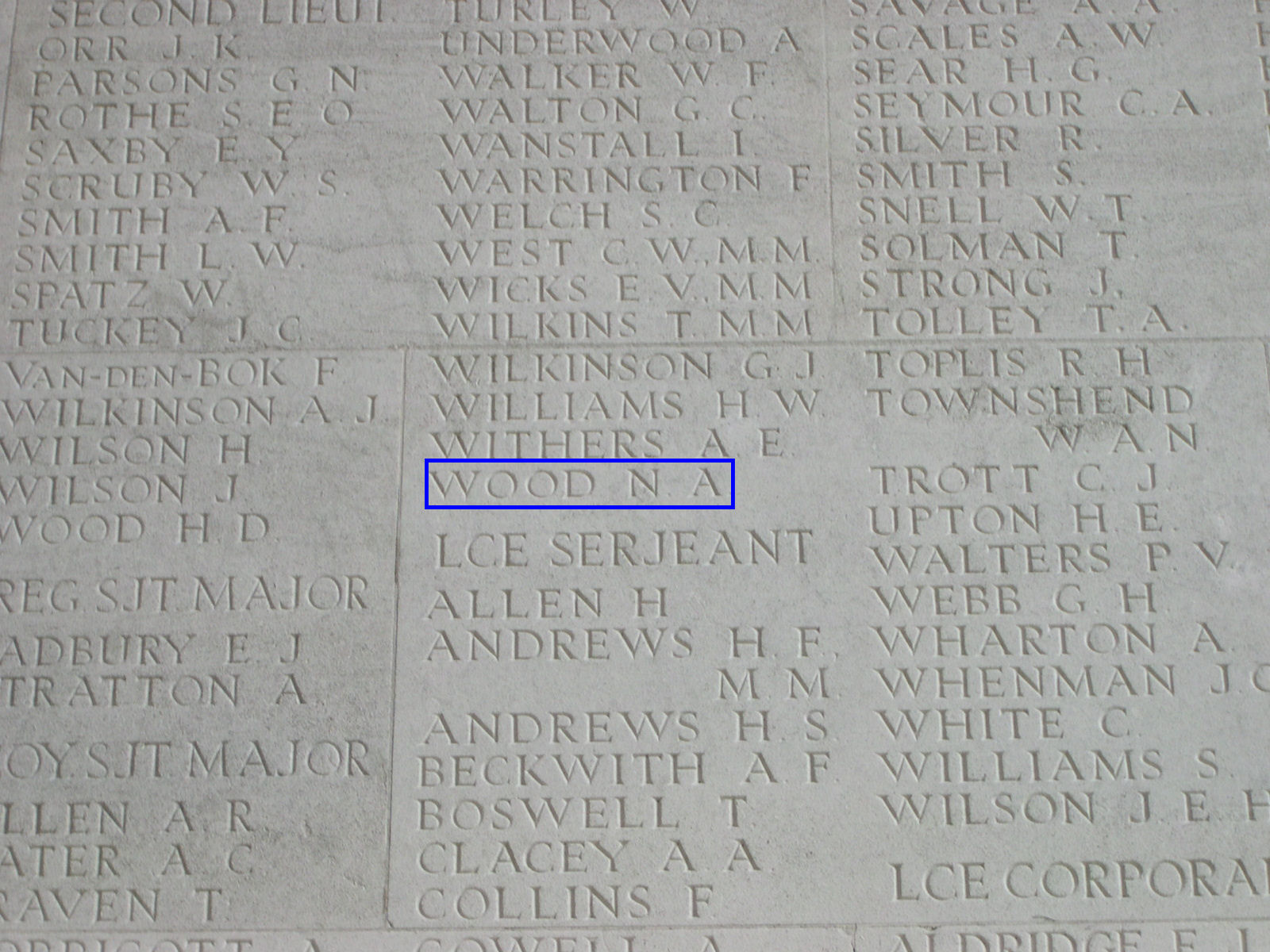
NORMAN WOOD played for Croydon Common in the 1911-1912 season, scoring 18 goals in his 38 games as an inside forward. His display against Chelsea Reserves so impressed the Football League side that they immediately put in a transfer bid and he moved across London, but he did not make any first team appearance for his new club. He was also on the books of Tottenham Hotspur early in his career, featuring on a Taddy Prominent Footballers cigarette card in 1908 in the club's kit, but he played no first team games there either. However, he made four representative appearances for the London Select XI around that time. He later played for Crystal Palace and Plymouth Argyle before joining the Robins and his last club was Stockport County. Oddly, he played in goal for the Robins in their record away win (12-2 v. Chesham Town in the Southern League on New Year's Day 1912) when the selected goalkeeper failed to arrive. At the outbreak of war, he enlisted in Chester and joined the 17th Battalion of the Middlesex Regiment, famously known as The Footballers' Battalion. As Serjeant F/663 in No. 3 Company, he was killed on 28 July 1916. Unfortunately, he has no known grave and so his name is listed on the Thiepval Memorial in France, along with 72,000 others. |
 |
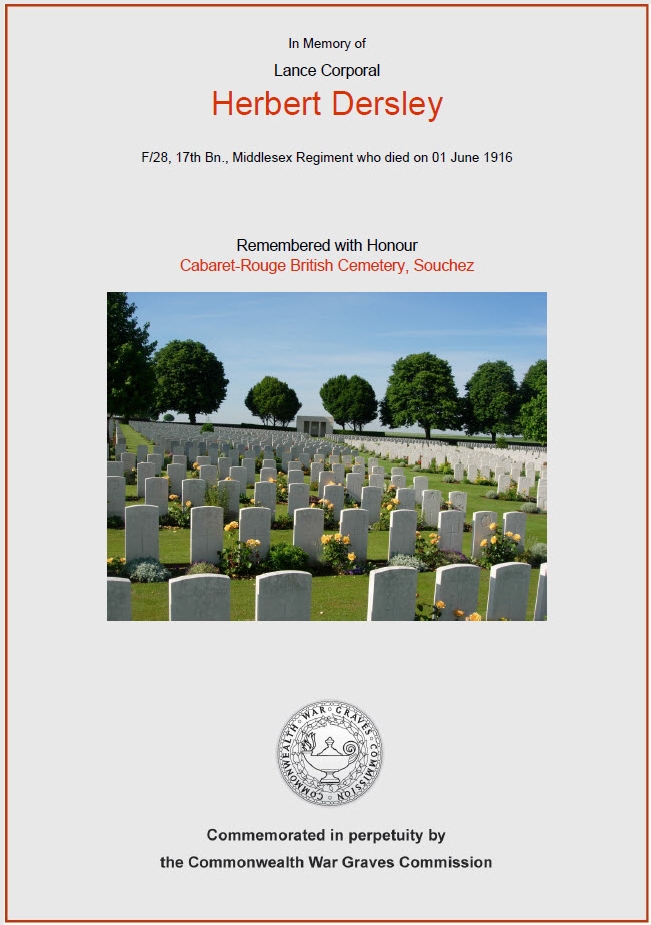 |
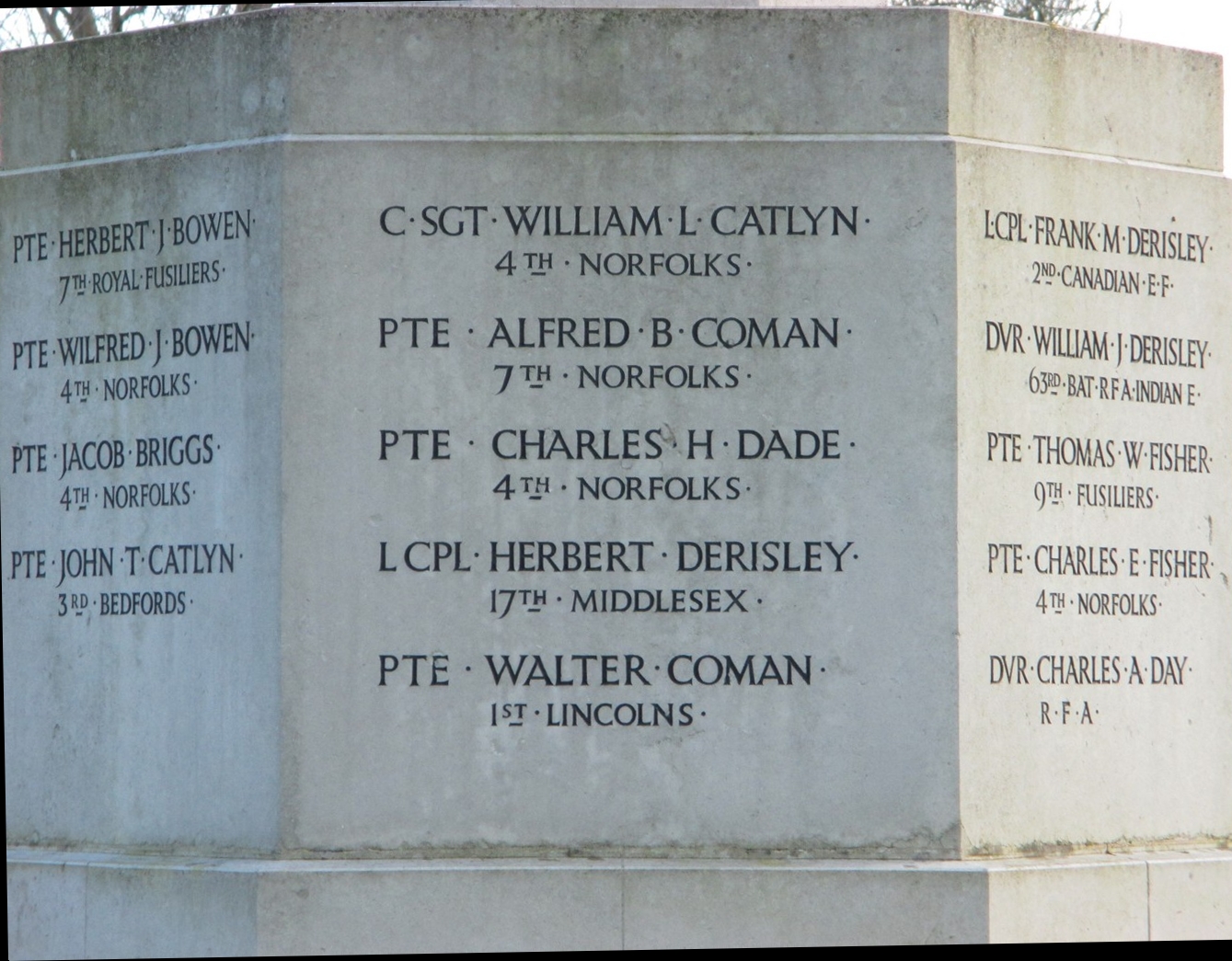
According to "The Greater
Game" by Clive Harris and Julian Whippy, which provides details of
footballers who died during the war, F/28 L/Cpl HERBERT DERSLEY of
the 17th Battalion of the Middlesex Regiment (the Footballers'
Battalion), who was living in Upper Norwood, Croydon when he was killed
in action on 1 June 1916, was a player with Croydon Common. This
may indeed be the case, but there is no record of him making any
appearances for the club's first eleven, although he could perhaps have
played for the reserve side. He is recorded on the
Commonwealth War Graves Commission's website as Herbert Dersley.
However, it would appear that his surname was actually Derisley.
"When the Whistle Blows" by Andrew Riddoch, which sets out a history of
the Footballers' Battalion, records that he was the nephew of a Crystal
Palace F.C. director and "The Final Season" by Nigel McCrery records
that he was an honorary steward for that club. He was born in
Hillingdon in Norfolk and is buried in Cabaret-Rouge Cemetery in
Souchez. A photograph of his name on the war memorial in Old
Buckenham in Norfolk appears on the left.
|
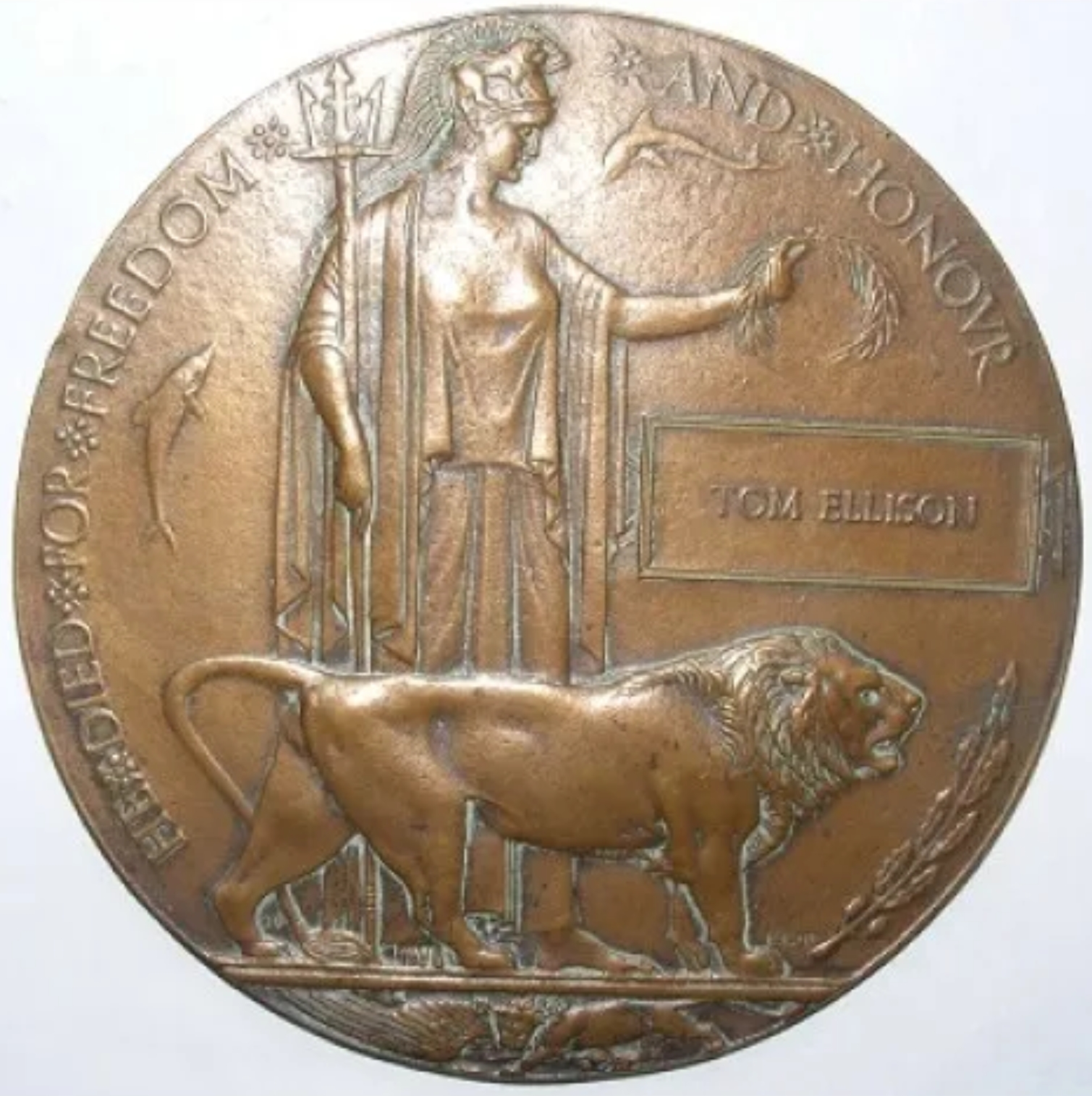 |
The next of kin of every British or Empire serviceman who died as a result of war service were presented with a Memorial Plaque. The plaque, which was cast in bronze and measured 120 mm in diameter, was often colloquially referred to as a widow's penny or a death penny. The one on the left bears the name of Tom Ellison and hence it could be the one that was presented to the next of kin of Croydon Common player Thomas Ellison (see above). However, there were at least five servicemen with that name killed in the war and the plaque bears no further information to show to which serviceman it relates. |